
Libya’s 2026 Job Market: The Shift We See & What It Means

A Market in Transition — Backed by Measurable Activity
Every year, the same question resurfaces:
Is Libya’s job market growing — or simply recycling the same opportunities?
The data tells a clearer story.
In 2025, we tracked over 1,500 jobs across the Libyan market. The activity was not linear. It peaked early in the year, softened mid-cycle, then accelerated sharply toward year-end.
Nearly 40% of total annual hiring activity occurred in the final quarter alone.
That concentration reflects structured workforce planning, business confidence, and tighter execution cycles heading into 2026. Hiring is becoming more deliberate and more time-sensitive.
The shift is measurable and directional.

2025 Hiring Activity: The Trend Behind the Shift
The trend reveals a clear cycle.
Peak month: February, accounting for roughly 15% of total annual hiring activity
Lowest month: April, representing around half of February’s share
From mid-year onward, hiring momentum rebuilt steadily. By Q4, activity had accelerated significantly; with the final quarter contributing nearly 40% of the year’s total hiring volume.
This confirms three structural realities:
Hiring volume remains strong.
Cycles are shorter and more decisive.
Timing directly influences access to opportunity.
For companies and professionals alike, timing is no longer secondary.
The Dual-Speed Market: Vertical Depth vs. Horizontal Breadth
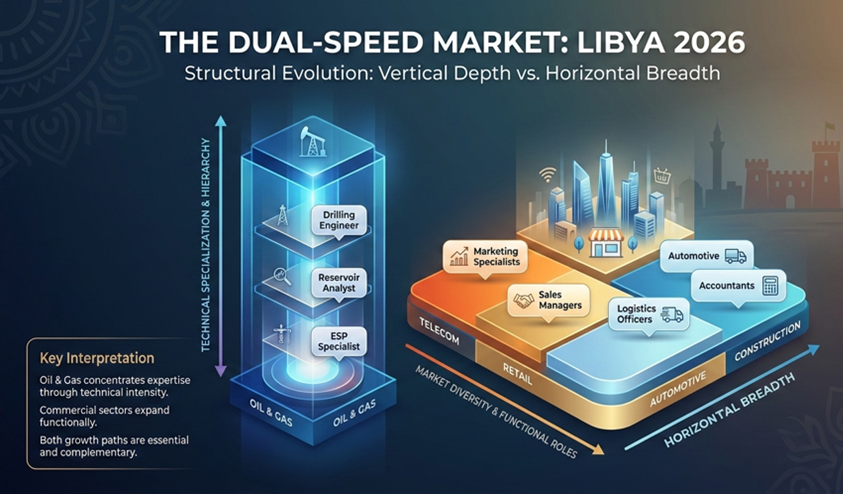
Libya’s employment structure is evolving into a dual-speed system — not just in sector growth, but in structural design.
Vertical Depth: Oil & Gas
Oil & Gas continues to represent vertical specialization.
This sector is defined by:
High technical barriers to entry
Layered hierarchies
Deep subject-matter expertise
Niche technical functions
Examples include ESP specialists, drilling engineers, reservoir analysts, QA/QC professionals, and advanced field operations roles.
Career progression moves upward through increasing technical specialization. Each role demands certification, field exposure, and domain precision.
Oil & Gas concentrates expertise. It builds depth.
What 2026 Will Reward
The coming year will favor:
Hybrid capability over narrow positioning
Commercial awareness alongside technical expertise
Decisive hiring execution from employers
Proactive positioning from professionals
Candidates who wait for visibility to find them will compete later in the cycle.
Companies that delay decisions will lose high-performing talent to faster-moving competitors.
Libya’s recruitment environment rewards readiness.
Horizontal Breadth: Expanding Commercial Ecosystems
In parallel, other sectors are expanding laterally across the economy:
Telecommunications & ICT
Retail & FMCG
Automotive & Commercial Trading
Construction & Infrastructure
These sectors scale through broader functional roles such as:
Accountants
Marketing specialists
Sales managers
Operations coordinators
Logistics officers
Customer service teams
Rather than building deeper technical stacks, these industries expand horizontally by increasing cross-functional capacity.
They scale through operational breadth.
Structural Implication:
The distinction is structural, not competitive.
Oil & Gas builds vertical depth through specialization intensity.
Telecom, retail, automotive, and construction expand horizontal breadth through functional diversification.
The 2026 market is not replacing one with the other.
It is layering breadth alongside depth.
Professionals who understand this architecture can position themselves accordingly: either by deepening specialization or broadening commercial capability.
Where Ejad Fits Into This Shift
As the market diversifies and accelerates, alignment becomes more complex.
The challenge is no longer whether opportunities exist.
It is whether professionals are positioned early enough to access them.
At Ejad, our role is to interpret where demand is growing and ensure our community stays aligned with that direction.
Through Connect, professionals receive relevant opportunities the moment they are published, placing them within the first visibility wave of each hiring cycle.
When nearly one-third of hires originate from proactive “connect”, one conclusion is unavoidable: Being visible early changes outcomes.
What the Percentages Reveal — And Why Positioning Creates Advantage
When a single month represents roughly 15% of annual hiring activity, and the final quarter captures nearly 40%, opportunity is clearly concentrated.
Hiring cycles cluster.
When clustering occurs, visibility windows shrink. Employers shortlist faster. Competition intensifies earlier.
Access becomes asymmetric.
In 2025, more than one-third of our successful hires, at Ejad, came from candidates who were already connected and received relevant job alerts immediately upon publishing.
They entered the process before market saturation. Thus, that early exposure materially increased their probability of selection.
In compressed hiring cycles, proximity to opportunity determines competitive advantage.
Final Perspective
Libya’s job market is structurally expanding.
Oil & Gas continues to drive vertical specialization.
Telecom is scaling through digital and enterprise integration.
Retail and automotive are professionalizing commercially.
Construction sustains infrastructure-driven demand.
2026 will reward those who understand the structure behind the movement and position themselves accordingly.
The shift is already underway, and the only remaining question is:
Will you connect before the next hiring cycle accelerates — or after it passes?